Open Office Too Noisy to Concentrate? How Sound Masking Quiets It
September 13, 2026
Quick Answer: Open-plan offices get noisy because nothing stands between one desk and the next to stop a voice from carrying, and low partitions or bench seating make it worse. Sound masking fixes this by emitting a steady, engineered background sound, tuned close to the frequency range of human speech, through speakers mounted in the ceiling plenum or on the exposed deck above the floor. That sound raises the ambient noise level just enough to shrink what acousticians call the radius of distraction — the distance at which a conversation stays clear enough to understand. A well-tuned system can take a conversation that carries 60 feet across an open floor and make it fall apart into background hum by around 20 feet. None of this cancels noise. It changes how far intelligible speech travels before your brain files it away as background hum.
You're three paragraphs into a report due by end of day when a sales call two rows over hits its stride. You can't make out every word, but you catch enough — a client name, a number, a laugh — that your eyes drift off the screen. By the time you catch yourself, you've lost the thread of what you were writing. Multiply that by a dozen small interruptions an hour, across every desk on the floor, and you get an office where people wear headphones just to fake being unavailable.
This is the daily reality in a lot of the open floor plans going up in Seattle office towers and South Lake Union tech buildings. Exposed ceilings, glass partitions, and bench seating look sharp in a listing photo. They also do nothing to stop a voice from traveling the length of the room, and facilities teams get blamed for "the noise problem" when the real issue is a space never built to control how far speech travels once it leaves someone's mouth.
Most people assume the fix is quieter employees or a noise-cancelling gadget on the ceiling. Neither really solves it. What works has been standard in call centers, law firms, and healthcare buildings for decades, and it works by adding sound to the room, not removing it.
What Sound Masking Actually Does
Here's the part that trips people up: sound masking doesn't cancel or absorb anything. It adds a steady, low-level background sound to a space, engineered to sit in the same frequency range as human speech — roughly the range your ear uses to pick apart consonants and tell one word from another.
The mechanism is simple once you see it. Your ear needs a wider gap between a nearby voice and the background hum to pull that voice into clear words. Sound masking raises the ambient floor just enough that speech a few desks away becomes indistinguishable murmur.
This differs from noise cancellation, a term thrown around loosely here. Active cancellation generates a wave that's the mirror opposite of an unwanted noise, so the two collide, which is how headphones fight an airplane drone. Sound masking instead adds energy the brain filters out.
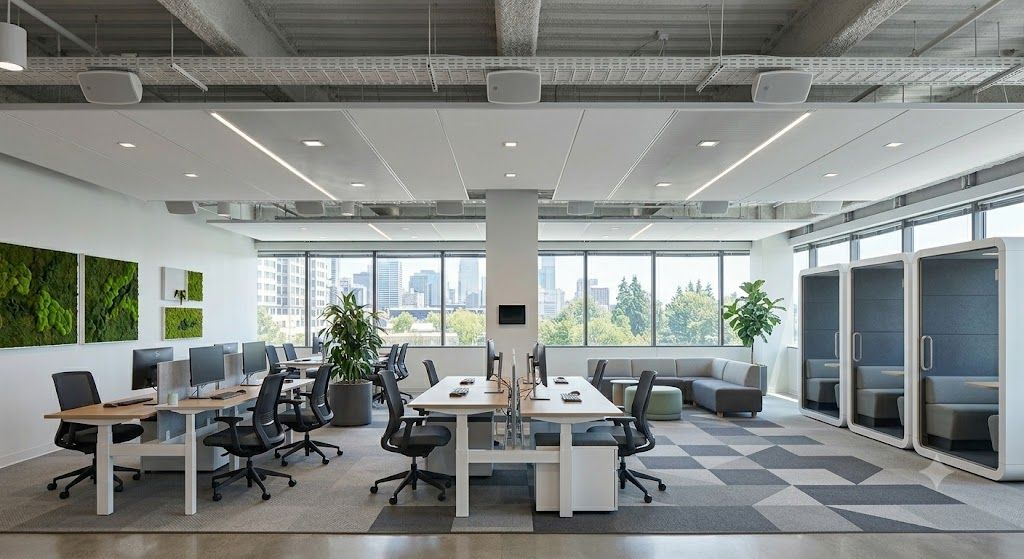
Properly designed systems don't run off one corner speaker. Emitters mount above the tile in the plenum, or hang as direct-field units under exposed deck, spaced on a grid. Wrong spacing or speaker type leaves hot spots people notice and cold spots doing nothing.
Why This Isn't the Same as a White Noise Machine
People often lump sound masking in with the small white noise machines sold for nurseries and hotel rooms. Both add sound, and both are meant to cover something else up. That's roughly where the similarity ends.
White noise carries equal energy across every frequency. Running it loud enough to cover speech means running it uncomfortably loud, and the result sounds like a radio caught between stations, a harsh static people start complaining about within a week rather than filtering out.
Sound masking, by comparison, is shaped. The curve favors the bands where speech lives, with extremes rolled off, sounding closer to gentle airflow than static. What reaches a desk also depends on ceiling tile, so exposed deck gets tuned differently than high-performance drop tile.
The other difference is control. A nursery machine has one volume knob and nowhere to point it. A commercial system is zoned and tuned desk by desk with a calibrated meter, set higher in open areas than in an enclosed office doing its own privacy work.
Tip: If your office already runs sound masking and people say it feels loud or hissy, that's usually a sign it was never properly commissioned after install, not a reason to shut the whole thing off. A technician walking the floor with a calibrated meter can often fix the complaint by rebalancing a handful of speakers rather than turning off the system entirely.
How Layout and Low Partitions Feed the Problem
Open-plan offices didn't get noisy by accident. They got noisy because most design choices that make a floor plan look modern also happen to remove everything that used to block sound.
Full-height cubicle walls once gave each desk a rough acoustic boundary, blocking sightlines and knocking down direct sound at the same time. Drop those walls to 42 inches or switch to open bench seating, and a normal voice now carries much farther before decaying to background level.
Seattle has plenty of these spaces. A converted SoDo warehouse with exposed brick and 14-foot ceilings looks great on a tour, but height works against you, since sound travels farther before bouncing. A glass-walled Bellevue high-rise has the same problem from hard, reflective surfaces everywhere.
Bench seating deserves its own mention. Common in Seattle tech offices because it's efficient and photographs well, it puts people shoulder to shoulder with only a shallow divider, if any. That means the acoustic work walls once did passively now has to happen actively instead.
The Ceiling Tile Decision Nobody Thinks to Make
Most people planning an office renovation treat ceiling tile as a visual choice. It's also an acoustic one, and it directly affects whether a masking system will work the way it's supposed to.
Acoustic ceiling tile is rated for how much sound it stops from passing through it, and that rating matters for whatever masking system sits above it. High-performance tile blocks a meaningful amount of sound energy, particularly at higher frequencies, before it reaches someone's desk. Thinner or lower-rated tile, or an exposed deck with no tile at all, lets much more of that signal through unfiltered, so a system tuned for one ceiling and installed under the other sounds wrong, either too harsh or too weak, no matter how well the layout was planned.
Older Seattle-area buildings retrofitted into open office space sometimes keep an original tin or plaster ceiling for character, or leave sections of deck exposed as a design feature — common moves in Pioneer Square and Fremont conversions. Either way, the masking system has to be designed around a ceiling condition the space was never built for, using direct-field speakers hung from the structure rather than the plenum-mounted approach a standard drop ceiling allows. Coordinating that decision with the AV design early, rather than after the ceiling package is already finalized, saves a callback later.
Signs Your Office Actually Needs This
Most facilities teams don't go looking for sound masking. They notice a pattern of complaints first, and only later learn there's a name for the fix.
The clearest sign is conversations carrying farther than they should. If someone can follow a phone call three or four desks away, catching names or numbers not meant for them, that's an acoustic gap, not one loud employee.
Then there's the prairie dog effect: heads popping up over partitions the moment someone hears their name, or laughter two rows over pulling others off task. If it happens several times a day, sound is traveling too far.
Concentration complaints are the quieter version. Not every distracted employee says something. Many just stop focusing, put on headphones by 9 a.m., or book conference rooms for work that only needs quiet. Near-universal headphone use is worth noticing.
Warning: Don't assume a partial fix, like adding a few desktop speakers running generic white noise from a phone app, will solve a floor-wide problem. A patchwork of consumer devices creates uneven coverage, inconsistent volume from desk to desk, and often the harsh, static-like sound that makes people want the whole thing turned off within a month. A floor-wide concentration problem needs a floor-wide, professionally tuned system, not scattered desktop gadgets.
What a Properly Designed System Actually Involves
Getting sound masking right in an existing office is less about buying hardware and more about understanding the floor it's going into. A real assessment starts with ceiling condition, partition heights, the actual layout, and how loud the space already runs before anything gets installed, since two floors in the same building can need two different approaches if one has drop tile and low partitions while the other has exposed deck and bench seating. Speaker placement follows from that assessment, and coverage needs field measurement and adjustment after install, not just a spec-sheet calculation on paper. Zoned systems let a facilities team run a different level in an open collaboration area than in a quieter zone nearby.
None of this replaces good judgment about layout and furniture. A masking system works with the partitions, ceiling, and floor plan you already have. It doesn't erase a bad layout decision, but it closes the gap between a modern, open floor plan and an office where people can get work done without wearing headphones all day.
Frequently Asked Questions
Does sound masking actually cancel noise, or just cover it up?
Neither, exactly. It doesn't cancel sound like noise-cancelling headphones, and it doesn't drown noise with something louder. It raises the ambient level just enough that nearby speech loses intelligibility sooner, staying audible but no longer clear.
Will employees be able to hear the sound masking system running?
In a properly tuned installation, most people stop noticing it within a couple of weeks. It's engineered to sound like gentle airflow rather than an obvious hum, close to what a quiet HVAC system already produces.
Can we just use a phone app or a desktop white noise machine instead?
Those help at a single desk but won't solve a floor-wide problem. A few desktop devices running plain white noise create uneven coverage and often run uncomfortably loud to compete, drawing complaints instead of solving them.
Does sound masking work with bench seating and low cubicle walls?
Yes, and it often matters more there than with taller partitions, since little or no physical barrier is already reducing how far speech travels. The system handles more of the acoustic work those partitions used to do.
How does ceiling tile affect a sound masking installation?
The tile above a workstation filters masking sound before it reaches the desk, and different tile types filter differently. A system built for standard drop tile won't sound right under exposed deck, so condition matters early.
Trading Constant Distraction for a Focused Working Floor
Audio Video Exclusives
has spent 35years designing systems around the ceiling conditions, partition heights, and floor layouts that Seattle, WA offices actually have, rather than the ones a spec sheet assumes. That difference shows up in how a room feels once a system is running, when the
masking
fades into the background instead of adding one more thing to notice. A floor tuned that way stops fighting its occupants, and concentration becomes the default state rather than the exception.